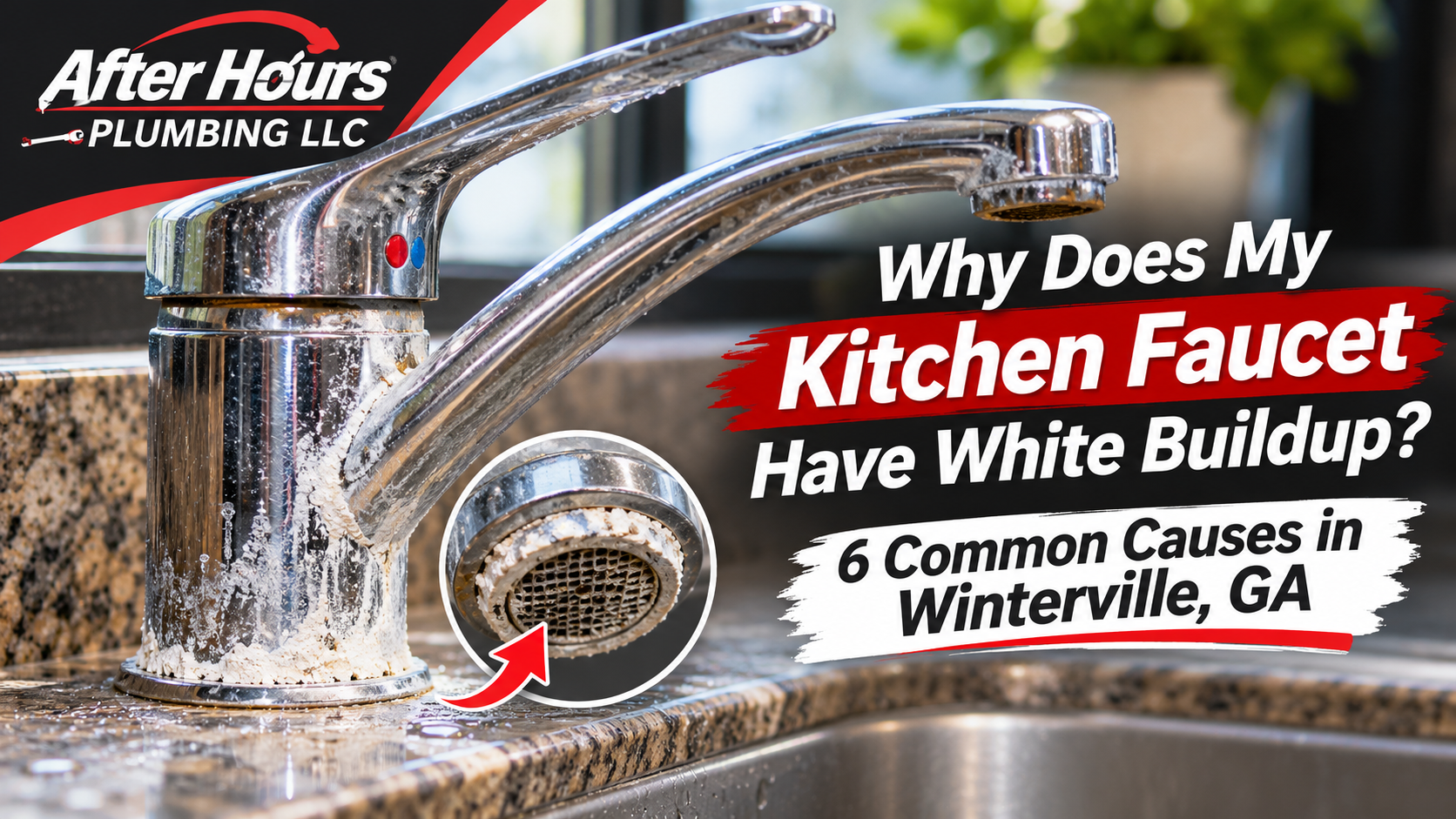
Have you noticed white, chalky, or crusty deposits forming around your kitchen faucet?
For homeowners in Winterville, GA, this buildup may be caused by minerals in the water, small leaks, or residue left behind when water evaporates.
While mineral deposits are often a cosmetic problem, heavy buildup can interfere with faucet performance and sometimes hide an underlying plumbing issue.
At After Hours Plumbing LLC, we help homeowners identify faucet problems, water pressure issues, and plumbing leaks.
Here are six possible reasons your kitchen faucet has white buildup.
1. Minerals in Your Water
Water naturally contains dissolved minerals, including calcium and magnesium.
When water evaporates from a faucet, these minerals can remain behind as white deposits.
The amount of buildup depends on the water's mineral content and how frequently the faucet gets wet.
Common signs include:
- White crust around the faucet
- Chalky deposits on fixtures
- Spots on dishes and glassware
- Reduced flow from the faucet aerator
A water quality test can help determine whether mineral content is contributing to the problem.
2. A Clogged Faucet Aerator
The aerator is the small screen or fitting at the end of many kitchen faucets.
Over time, mineral deposits and debris can collect inside it, restricting water flow.
You may notice uneven spraying, splashing, or reduced water pressure at the kitchen sink.
Cleaning or replacing the aerator may restore normal performance.
3. A Small Faucet Leak
A faucet that drips around its base, handle, or spout can leave mineral deposits as the water evaporates.
If white buildup repeatedly returns to the same location, inspect the area for moisture.
A plumber in Winterville can determine whether the faucet needs a new seal, cartridge, or another repair.
4. Hard Water
Hard water contains relatively high concentrations of dissolved calcium and magnesium.
It can contribute to scale buildup on faucets, showerheads, and certain plumbing appliances.
Some homeowners may also notice soap that does not lather easily or mineral spotting on bathroom fixtures.
Water testing can help determine whether a water treatment system would be beneficial.
5. Cleaning Product Residue
Not every white deposit comes from water minerals.
Certain cleaning products can leave a cloudy film or residue when they dry.
Before assuming your plumbing has a problem, check whether the buildup appears after cleaning.
Use cleaning products approved by the faucet manufacturer to avoid damaging the finish.
6. Corrosion or Deteriorating Faucet Components
In some cases, deposits around a faucet may be associated with corrosion or deteriorating components.
Signs that deserve attention include visible pitting, recurring leaks, loose connections, or damaged metal surfaces.
A plumber can inspect the fixture and recommend repair or replacement when necessary.
How Do You Remove White Buildup From a Faucet?
For compatible faucet finishes, gentle cleaning with a soft cloth and a manufacturer-approved cleaner may remove mineral deposits.
Avoid abrasive pads and harsh chemicals that could damage protective coatings.
If the aerator is clogged, follow the manufacturer's instructions for removal and cleaning.
When Should You Call a Plumber?
Consider professional plumbing service if the buildup returns quickly, the faucet leaks, or water pressure remains low after basic cleaning.
A plumber can inspect the faucet, check for hidden leaks, and determine whether mineral buildup is affecting other plumbing components.
Kitchen Faucet Repair in Winterville, GA
If your kitchen faucet is leaking, clogged, or experiencing reduced water flow, After Hours Plumbing LLC can help.
We provide faucet repair, fixture replacement, leak detection, and residential plumbing services in Winterville, Athens, Watkinsville, Bogart, and surrounding Georgia communities.
Call After Hours Plumbing LLC at (706) 248-5934 to schedule professional plumbing service.
Related Services & Local Links
Explore the services mentioned in this article: