When it's time for a new water heater, homeowners have more choices than simply replacing the old tank with another one.
Traditional tank water heaters remain common, while tankless systems have become an increasingly considered alternative.
For homeowners in Athens, GA, the right choice depends on your household's hot-water needs, available space, budget, and long-term priorities.
Here's how the two options compare.
How Does a Traditional Water Heater Work?
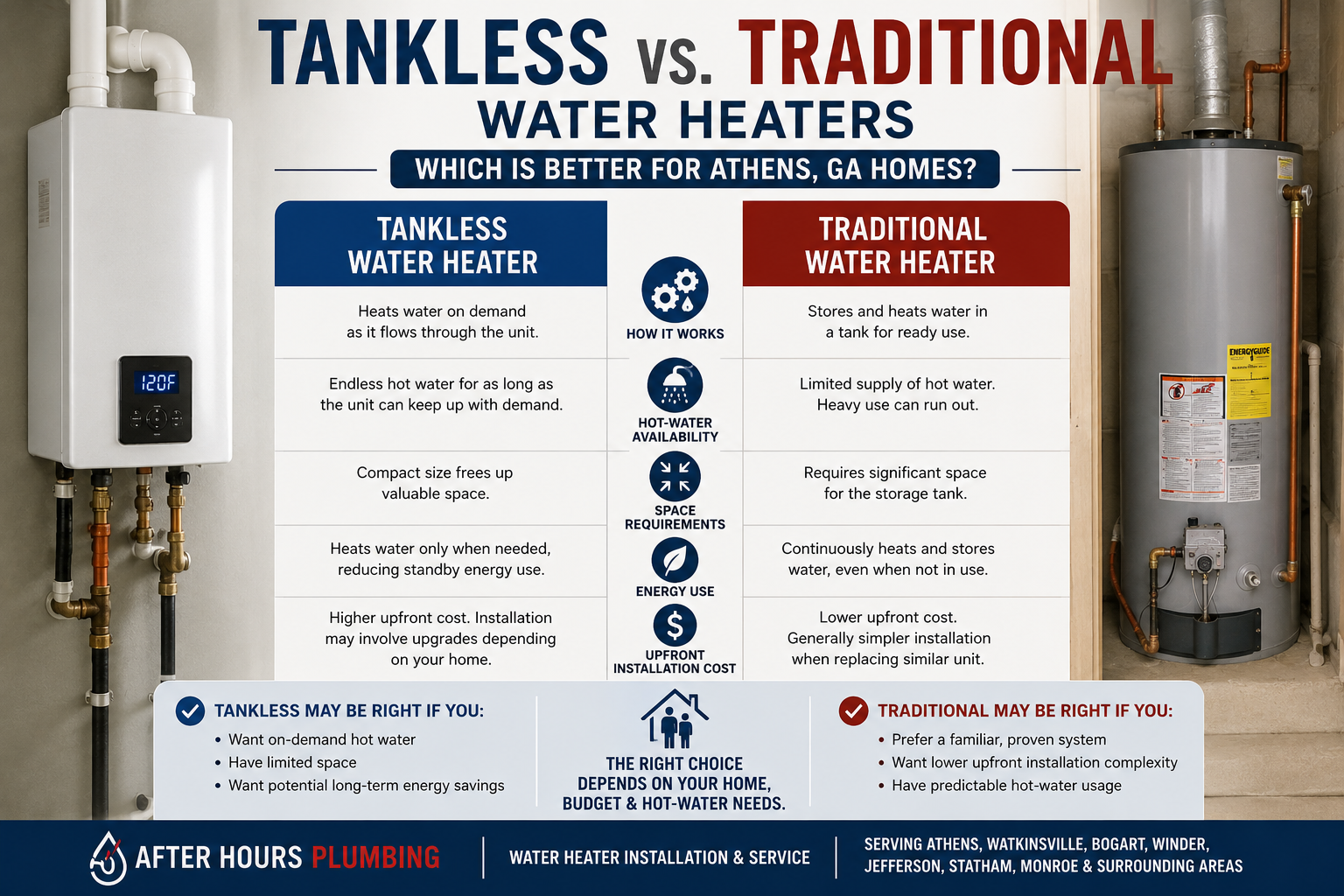
A traditional water heater stores heated water inside a tank.
When you turn on a hot-water fixture, heated water leaves the tank and is replaced with incoming cold water that must then be heated.
Tank systems are familiar, widely used, and available in different capacities.
How Does a Tankless Water Heater Work?
Instead of storing a large supply of hot water, a tankless system heats water as it's needed.
When a hot-water fixture is activated, water moves through the unit and is heated before being delivered to the fixture.
This eliminates the need for a traditional storage tank.
Hot-Water Availability
Tank systems have a limited amount of heated water available at one time. Heavy usage can temporarily exhaust the supply.
Tankless systems don't rely on a stored tank of hot water, but they still have capacity limitations based on flow rate and system sizing.
Proper sizing matters with either option.
Space Requirements
Traditional water heaters require room for the storage tank.
Tankless units are considerably more compact and can be useful when homeowners want to free up floor space.
However, installation requirements depend on the home and the specific system.
Energy Use
A traditional tank maintains a supply of heated water, including during periods when nobody is using it.
Tankless systems heat water on demand, which can reduce standby energy use.
Actual efficiency and operating costs depend on the equipment, household usage, fuel source, and other factors.
Upfront Installation Cost
Traditional tank water heaters generally have a simpler replacement process when a similar unit is being installed.
Tankless installation can involve additional considerations depending on the home's existing plumbing, electrical system, gas supply, venting, and other requirements.
Homeowners should compare the total installed cost rather than only the price of the equipment.
Which Is Better for Your Home?
There isn't one answer that works for every household.
A traditional water heater may make sense for homeowners who prefer a familiar system and lower initial installation complexity.
A tankless system may appeal to homeowners who value a compact design, on-demand operation, and long-term efficiency.
The right choice depends on your home's setup and your family's hot-water demands.
Water Heater Service in Athens, GA
If you're considering replacing or upgrading your water heater, After Hours Plumbing can evaluate your home's needs and discuss appropriate options.
After Hours Plumbing serves Athens, Watkinsville, Bogart, Winder, Jefferson, Statham, Monroe, and surrounding Northeast Georgia communities.
Contact After Hours Plumbing at (706) 248-5934 to discuss your water-heater options.
Related Services & Local Links
Explore the services mentioned in this article:
- Water Heater Repair — Athens, GA
- Emergency Plumber — Athens, GA
- Leak Detection — Athens, GA
- Fixture Installation
- Plumber — Athens, GA
- Plumber — Athens-Clarke County, GA
- Water Heater Repair — Athens-Clarke County, GA
- Emergency Plumber — Athens-Clarke County, GA
- Leak Detection — Athens-Clarke County, GA